
Florence County Criminal Court Records
A criminal court record in Florence County is the case-level file kept once a charge is filed or transferred into court. For serious offenses, that usually means the Court of General Sessions, the criminal division of the South Carolina Circuit Court. Florence County is in the Twelfth Judicial Circuit with Marion County, and the Clerk of Court maintains General Sessions records at the county courthouse. The file may show the original charge, amended charges, indictment activity, motions, hearing entries, plea terms, verdict, sentence, restitution, probation terms, and appeals.
Lower-level criminal matters can start or remain in Magistrate Court or Municipal Court. Florence County Magistrate Court handles summary criminal work, bail, preliminary hearings, arrest warrants, and related matters. Municipal courts handle traffic, ordinance, and lower criminal cases inside city or town limits. A booking record may show an arrest and a listed charge, but the full Florence County criminal court record is the better source for what was filed, how the charge changed, and whether it ended in a conviction, dismissal, or other disposition. For the arrest-to-charge path, see the Florence County arrest records and court charges page.
The Twelfth Circuit Public Defender page is one official source tied to local criminal cases and appointed defense. Its Florence County role helps show that criminal court records are part of a larger case system, not just a list of arrests.
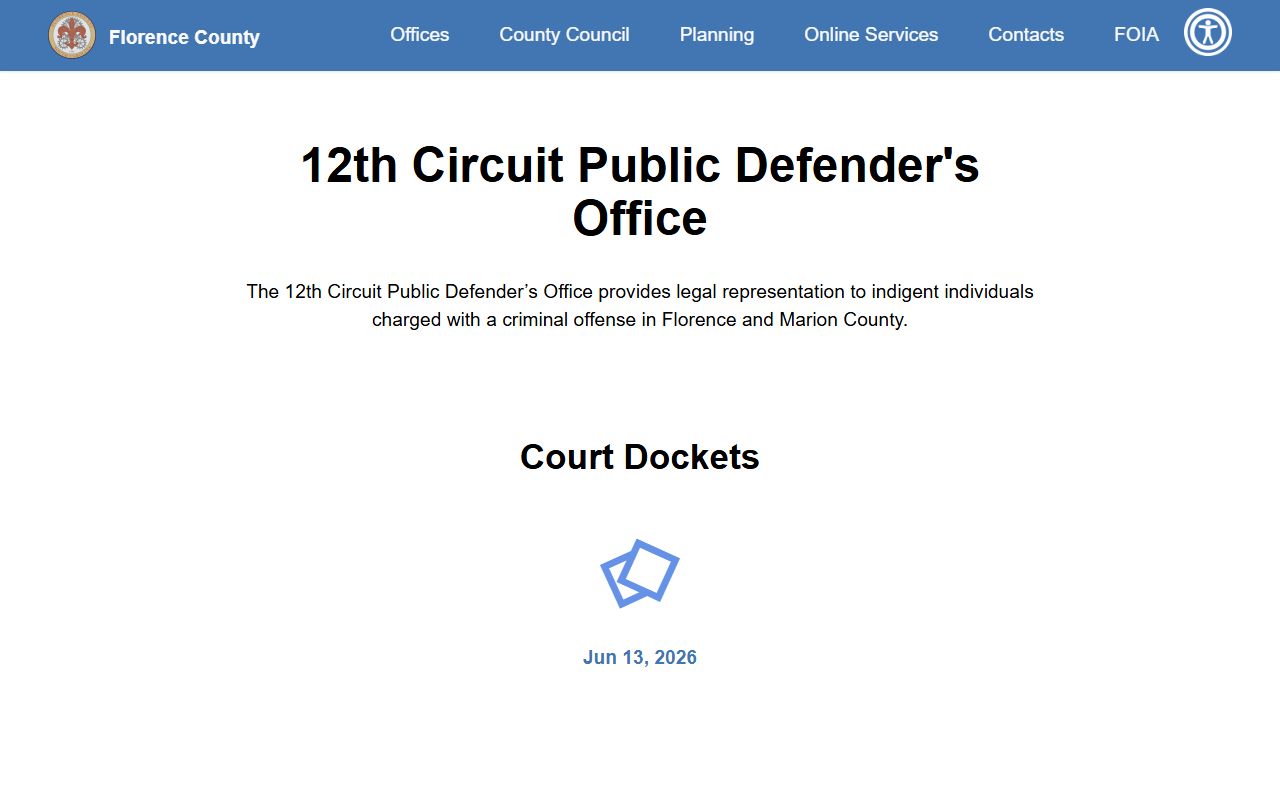
The public defender source matters because eligible defendants may have counsel appointed during the same case events that later appear in the criminal court file.
Search Florence County Criminal Cases
The official online route for Florence County criminal court records starts with the South Carolina Judicial Branch case records search. Users choose Florence County from the public index county list, then open the Florence public index. The state system requires cookies and JavaScript, and case details may require a pop-up exception. Court rosters are separate from case history, so a person checking an upcoming criminal appearance may also need the Florence court rosters link.
- Open the state case-records search page and choose Florence County or Circuit 12 from the public index options.
- Use the Florence public index for case-record searching. Use the court roster page when the goal is a hearing list or docket date.
- Search with the most exact information available, such as defendant name, case number, court type, or known hearing details.
- Open the case detail and read the docket entries, filed charges, disposition, sentencing entries, and any public documents available through the system.
- Contact the Clerk of Court when a certified copy, older record, or non-digitized criminal case file is needed.
Florence County does not appear to run a separate county-built criminal case search for Circuit Court records. The Clerk page routes users to South Carolina public index records and court rosters. General Sessions docket and prosecution information may also connect to the Florence County Solicitor, whose page lists trial lists, docket appearance schedules, diversion programs, warrants, expungement, and payments.
The SCCID Florence public defender contact page also identifies local public defender resources for defendants in Florence County criminal matters.
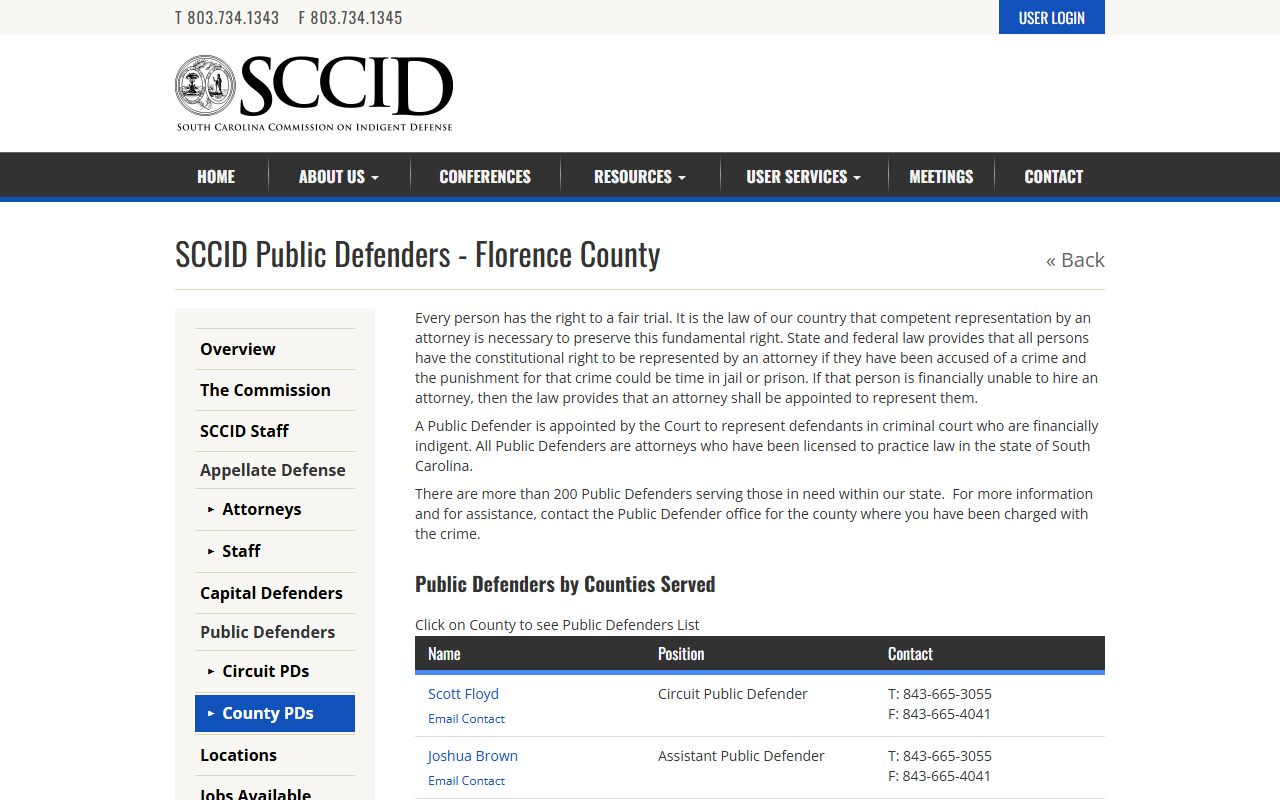
That state public-defender contact can help readers distinguish court case access from legal representation questions, which are handled through official defense channels.
Florence County Criminal Case Flow
Criminal court records grow as a case moves through the court system. A warrant, arrest, or booking entry may come first, but the court record becomes more useful after the charging decision and court filing. In a Florence County felony case, General Sessions entries can show indictment, arraignment, motions, plea negotiations, trial settings, disposition, and sentencing. In summary court, the same broad idea applies at a smaller scale, but the venue may be Magistrate Court or a municipal court.
Case flow: Charges Filed › Arraignment › Pretrial and Motions › Plea or Trial › Disposition › Sentencing
| Stage | What the Record May Show |
|---|---|
| Charges Filed | The offense alleged, court type, prosecutor or arresting agency link, and case number when opened. |
| Arraignment | Formal notice of charges and plea-related entries when the court records that event. |
| Pretrial and Motions | Continuances, bond changes, suppression motions, discovery activity, hearings, and orders. |
| Plea or Trial | Plea terms, verdict, dismissed counts, amended charges, or trial result. |
| Disposition and Sentence | Outcome, fines, restitution, probation, jail or prison terms, and appeal entries when public. |
The General Sessions expungement process is tied to the same court level that handles felony criminal files.
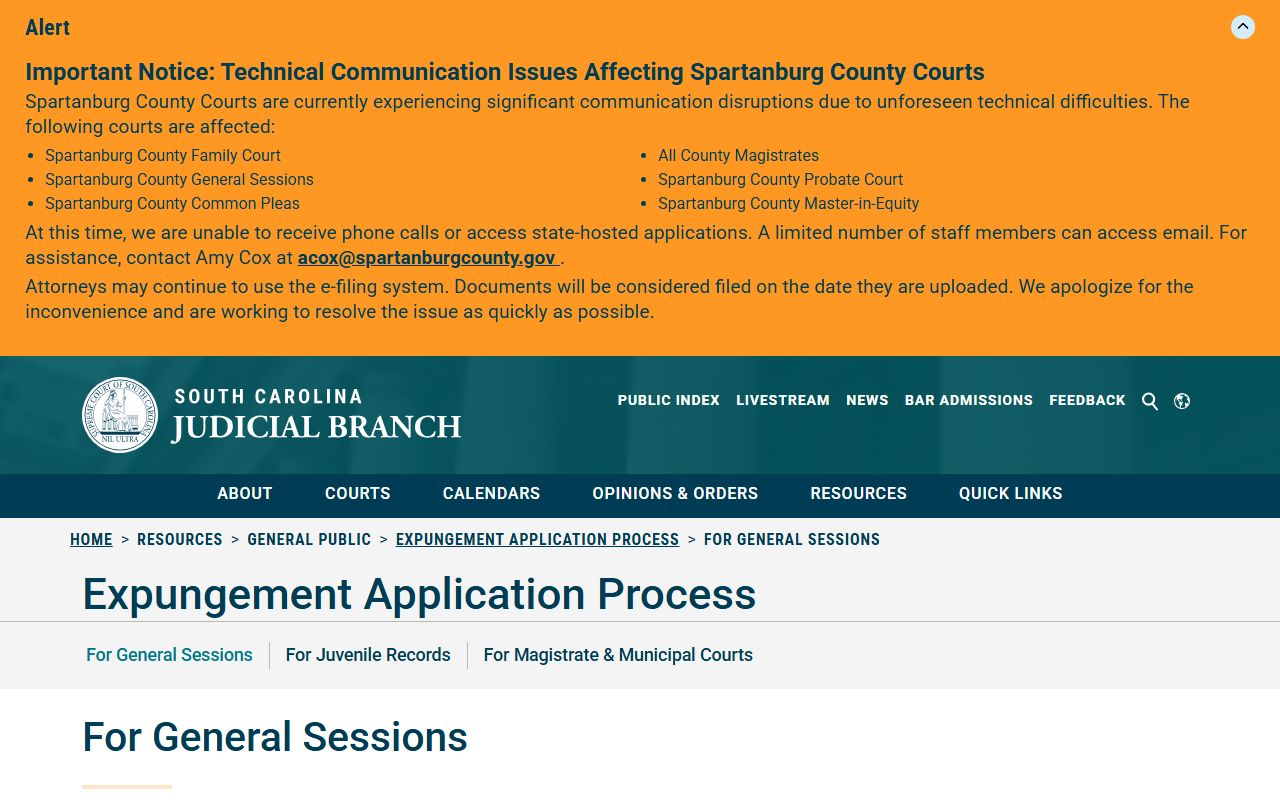
General Sessions expungement guidance is useful because it points to the court and solicitor path for qualifying criminal charge outcomes.
What Florence Criminal Records Show
Florence County criminal court records should be read field by field. One case can list several charges, and each charge can have a different result. A single defendant may also have jail booking data, warrant data, court case data, and probation or prison data in separate systems. The court file is the source for court actions and outcomes, while the jail roster is a custody source and the warrant list is a law-enforcement source.
| Field | What It Shows |
|---|---|
| Case number | The court identifier, often showing year, county or court code, and sequence. |
| Court division | General Sessions, Magistrate, Municipal, Family Court, or another court tied to the case. |
| Defendant and parties | The defendant name and prosecuting agency or state party where shown publicly. |
| Charges | Filed counts, offense descriptions, amended charges, dismissed charges, or reduced counts. |
| Docket entries | Hearings, motions, continuances, notices, orders, returns, and sentencing events. |
| Disposition | The outcome of each charge, such as guilty plea, not guilty, dismissal, or nolle prossed. |
| Sentence | Jail, prison, probation, fines, costs, restitution, or other court-ordered terms when public. |
The Judicial Branch announced that home address information is no longer displayed on the public index for new and existing cases as of January 1, 2026. That affects public expectations when reading Florence County criminal court records online.
Florence Charges vs Convictions
A charge is an accusation. A conviction is an outcome. Florence County criminal court records may show charges that were later amended, reduced, dismissed, nol prossed, or resolved with a guilty plea or verdict. The phrase nolle prossed means the prosecutor declined to proceed with that charge. It is not the same as a conviction. The disposition line matters more than the initial charge label when a reader is trying to understand the final result.
| Point | Charge | Conviction |
|---|---|---|
| Meaning | An allegation filed after arrest or investigation. | A guilty plea, verdict, or finding entered by the court. |
| Timing | Early in the case or after amendment. | Near the end of a count or case. |
| Record risk | May remain visible unless sealed or expunged. | Often appears with sentence and court costs. |
| Best field to check | Charge description and count history. | Disposition and sentence fields. |
The South Carolina expungement overview explains that some dismissed, not-guilty, nol-prossed, diversion, and limited conviction records may qualify for removal or sealing through a statutory process.
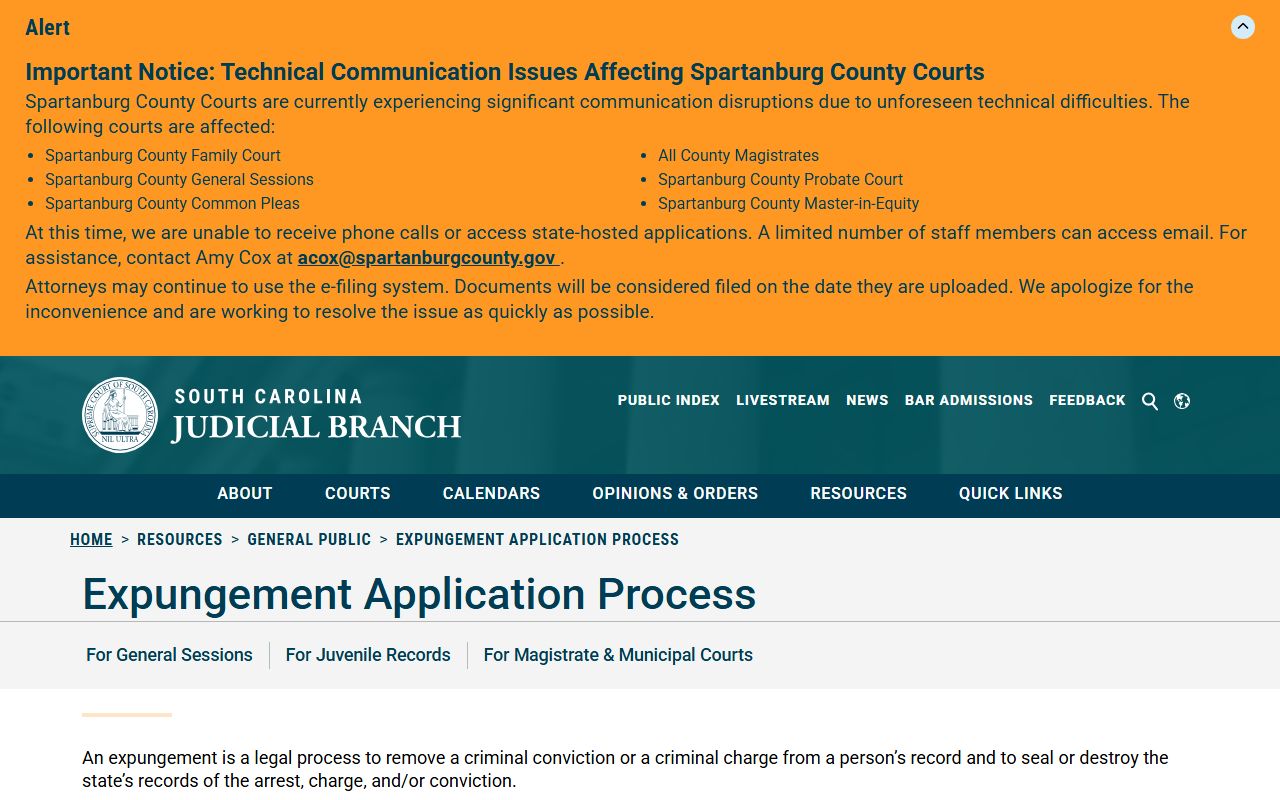
Expungement rules are central to Florence criminal record access because a once-public charge may later stop appearing in public systems.
Public Access to Florence Criminal Records
Public access to Florence County criminal court records comes from both court-record rules and South Carolina public-record law. E-Filing Rule 10 allows public access to case status and party-filed documents through the public index, but sealed cases and sealed documents are not publicly available. South Carolina FOIA supports access to public records unless an exemption or separate law applies, but court files also follow court rules and sealing orders.
Access limits: A public index result is not the same as a certified court copy. Certified copies come from the Clerk of Court.
South Carolina Title 17 expungement statutes control which criminal charges or convictions may be expunged and what procedure applies.
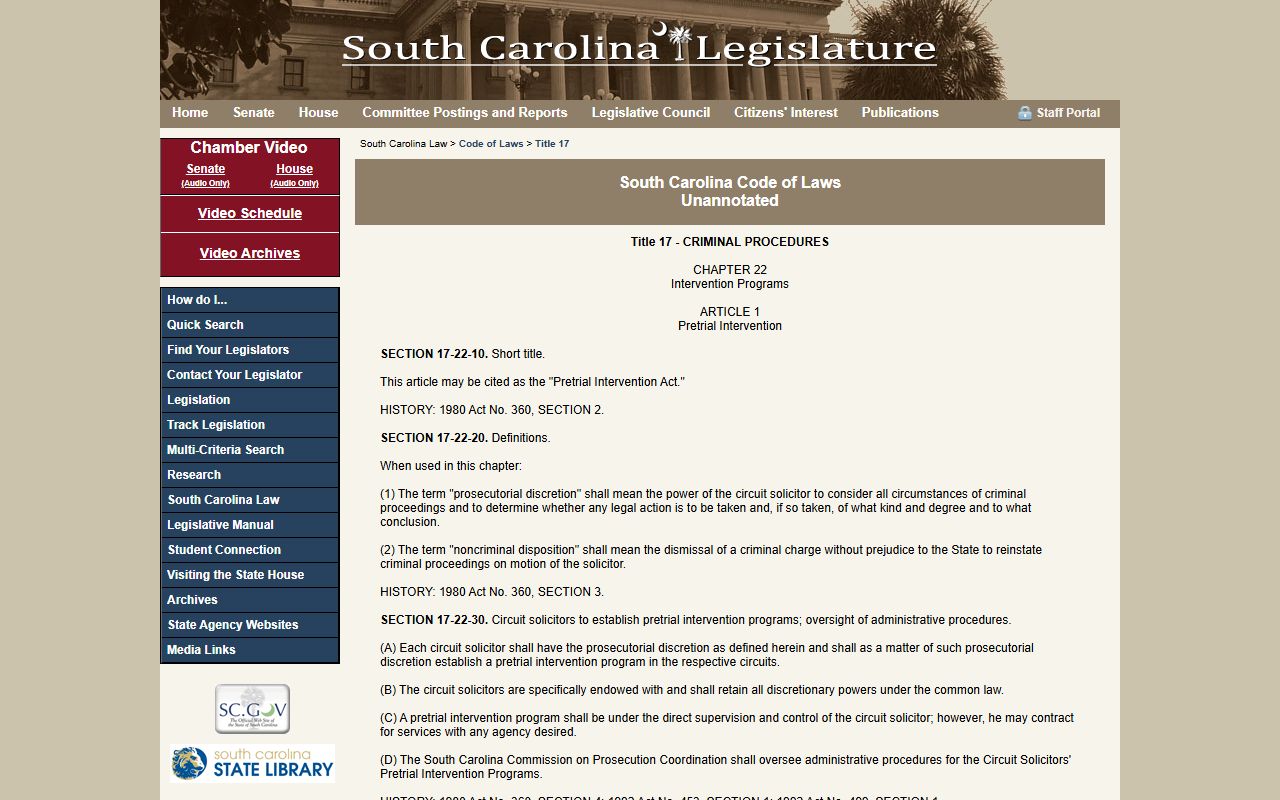
The statute source is important because public criminal record access can change after a court signs an expungement order.
Restricted Florence Criminal Records
Not every Florence County criminal court record is public. Juvenile matters are treated differently from adult criminal cases. South Carolina juvenile-record law makes Family Court juvenile records confidential and generally open only by court order to persons with a legitimate interest. Adoption cases are also sealed under separate law. Mental-health and commitment matters may be restricted through Probate Court or other rules.
| Point | Sealed Record | Expunged Record |
|---|---|---|
| Public view | Hidden from public access by law or court order. | Removed, sealed, or destroyed under an expungement order. |
| Common reason | Juvenile, adoption, protected filing, or court order. | Eligible dismissal, nol pros, not guilty, diversion, or limited conviction result. |
| Where to verify | Clerk of Court or issuing court. | Solicitor, summary court, Clerk of Court, or SLED path as applicable. |
The juvenile-record statute is a key limit when a Florence County criminal search involves a person who was under juvenile court jurisdiction.
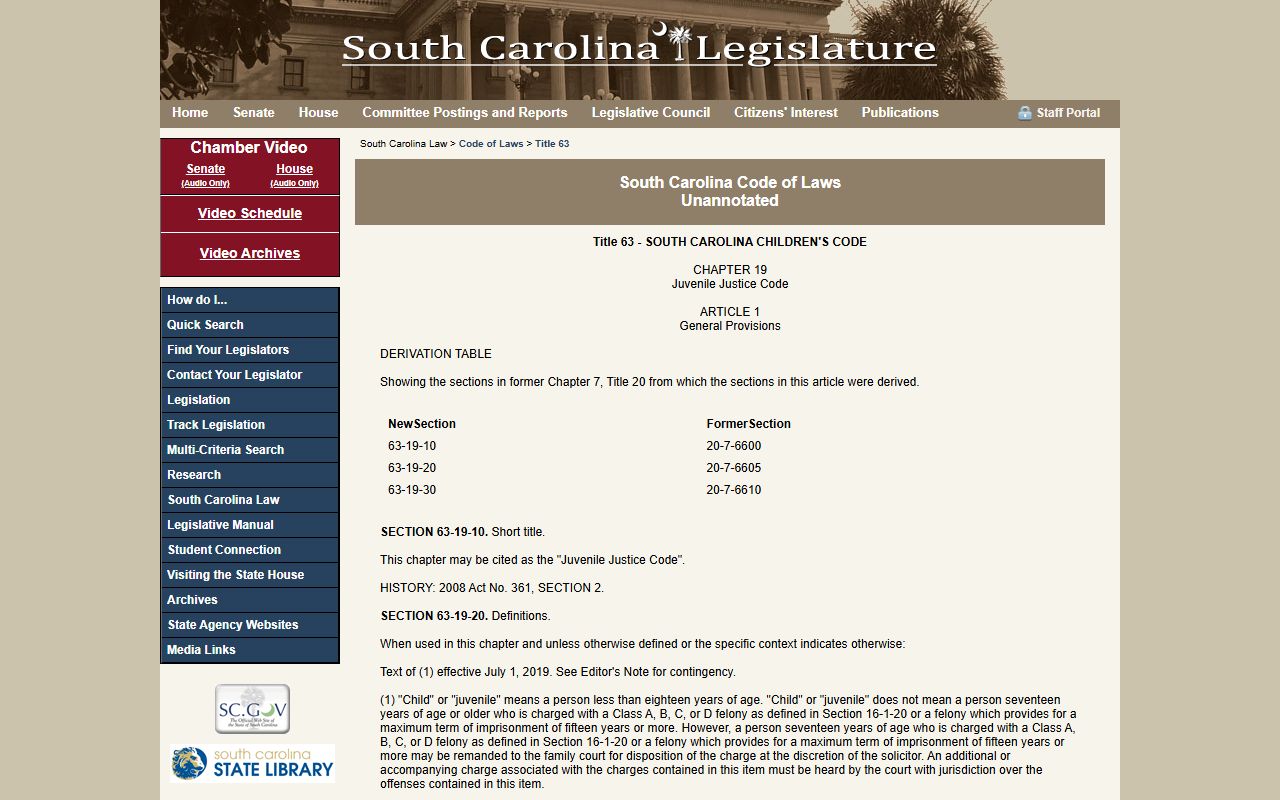
Juvenile confidentiality is why public criminal case tools should not be expected to show every law-enforcement or court contact.
Note: For employment, tenant, credit, insurance, or other regulated screening, use a compliant consumer-reporting process rather than an informal search.