
Florence County Arrest Records and Charges
Florence County arrest records begin with law enforcement and detention records. The Florence County Sheriff's Office and Florence County Detention Center can show that a person was booked, the listed charge, offense date, court type, bond, bond type, and arresting agency. That is not the same as the final court result. A booking charge is a starting point. It may later be changed by the solicitor, handled in a summary court, sent to General Sessions, or resolved without a conviction.
Court charges after arrest are the formal accusations that move through court. In Florence County, serious criminal prosecution is tied to the Twelfth Judicial Circuit Solicitor, while Magistrate Court and Municipal Court handle many lower-level criminal and traffic matters. The full case file and sentence are covered in Florence County criminal court records. Custody status and jail roster details belong on the inmate records page.
The Florence Detention Center charge-description grid is an official source for charge descriptions connected to the booking system.
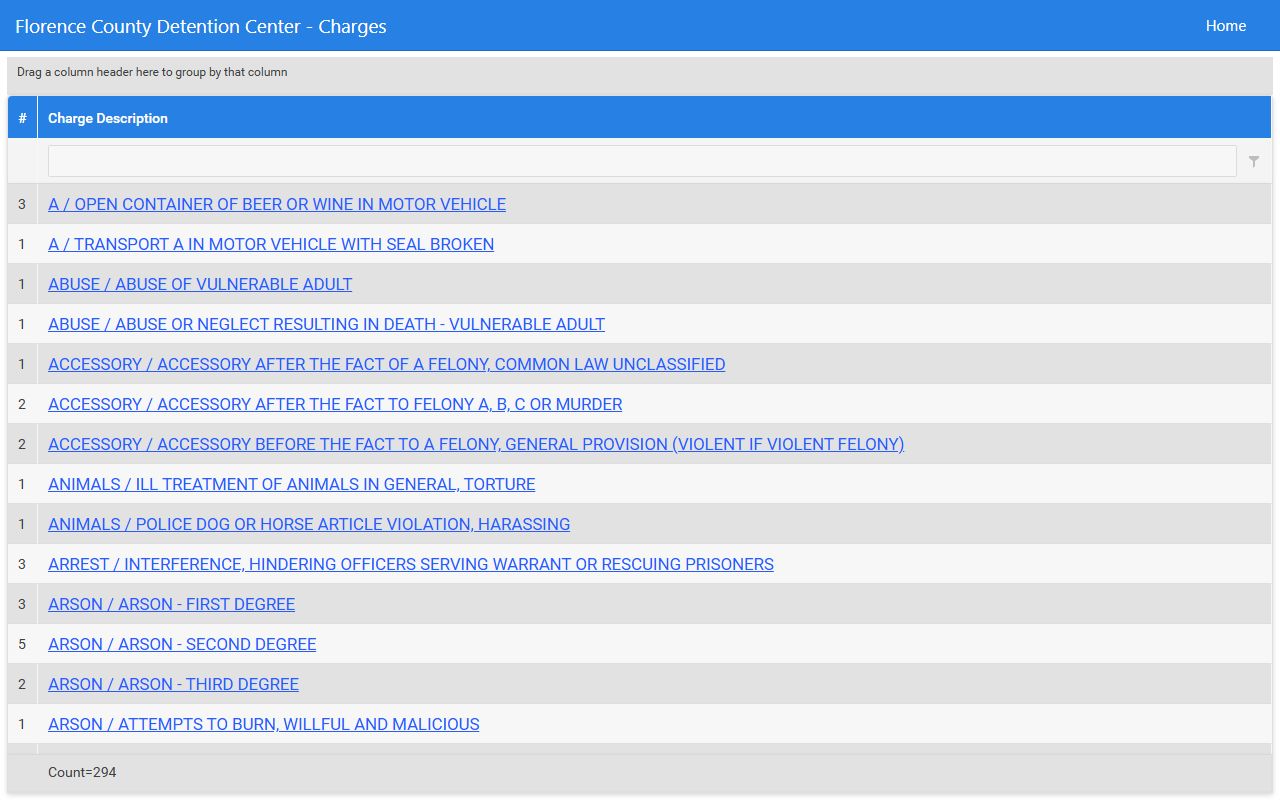
The charge grid is useful for reading arrest records, but the court docket must be checked to learn how a charge was filed and resolved.
Find Florence Arrest Records and Charges
Florence County uses several access channels because no single page holds every arrest and charge fact. Jail booking records are maintained by the sheriff and detention center. Court charges may appear in the South Carolina public index for Florence County, in Magistrate or Municipal Court records, or in General Sessions files. Solicitor records can matter when the charge is pending in the Twelfth Judicial Circuit, diverted, or reviewed for expungement.
- Start with the sheriff or detention booking portal when the question is whether someone was recently booked or what charge was listed at intake.
- Use the South Carolina Judicial Branch public index for Florence County to check the court case, charge history, docket, and disposition.
- Check Magistrate Court or the proper Municipal Court if the charge is a summary offense, city ordinance case, or traffic matter.
- Use the Solicitor channel for General Sessions prosecution, diversion, trial lists, expungement, and criminal warrant information.
- Use FCSO FOIA when an incident, arrest, report, or sheriff record is not provided through the public tools.
The Florence County Detention Center booking portal shows charge, offense date, court type, bond, bond type, and arresting agency on inmate detail screens. The South Carolina public index is the court-record path for docket events and dispositions. A reader should compare both before treating a listed arrest charge as the final court outcome.
Charges After Arrest in Florence County
After an arrest, the listed booking charge may not be the same as the charge that moves forward in court. A prosecutor can proceed, amend, reduce, dismiss, or decline a charge. South Carolina calls prosecutors solicitors, and Florence County is in the Twelfth Judicial Circuit. Solicitor E.L. Clements III is identified on the county solicitor page, which also lists trial lists, initial and docket appearance schedules, diversion programs, expungement applications, criminal warrant information, and online payment categories for several programs.
| Charging Record | Who Uses It | Florence County Context |
|---|---|---|
| Complaint or warrant-linked charge | Law enforcement, Magistrate Court, Municipal Court, or prosecutor | May appear first in arrest, bond, warrant, or summary court records. |
| Information or prosecutor filing | Solicitor | Used when the prosecutor files or manages the formal charge path. |
| Indictment | Grand jury and General Sessions | Common in felony General Sessions cases before plea or trial. |
For charge records after arrest, the key question is not only what offense was listed, but where the charge is pending. A Florence Municipal Court misdemeanor differs from a General Sessions felony, and both differ from an FCSO booking entry.
Florence Charge Status Terms
Charge status can change as facts, evidence, plea talks, court orders, and diversion decisions develop. Florence County arrest records may list the charge used at booking, while the later court record may show a different status. A charge can be pending on one date and dismissed or nol prossed later. It can also be reduced as part of a plea or amended when the prosecutor changes the formal accusation.
| Status | What It Means |
|---|---|
| Pending | The charge has not reached a final court disposition. |
| Amended | The filed charge changed, often to correct or alter the accusation. |
| Reduced | The charge became a lesser offense, often through plea or prosecution review. |
| Dismissed | The court or prosecution ended that charge without a conviction on that count. |
| Nolle prossed | The solicitor declined to proceed with that charge. |
| Guilty or convicted | The charge ended in a guilty plea, verdict, or finding with sentencing terms. |
Note: Always check the latest court disposition because an old booking charge can stay online after the court result changes.
FCSO Records and FOIA Requests
The Florence County Sheriff's Office has a separate FOIA channel for sheriff records. The FCSO FOIA request instructions state that requesters may use the sheriff form and fee schedule for copies, reports, recordings, staff time, and media. The research file identifies a 2026 FOIA request form and fees such as per-page charges, staff time, discs, Blu-Ray media, and a possible deposit. Those sheriff records are separate from Clerk of Court files.
FOIA can help when the public booking portal or court index does not provide the requested arrest report or incident record. It does not turn a sheriff report into a court disposition. If the request is about the court charge, the case docket, certified copies, or a final order, the Clerk of Court or the issuing court is the better channel.
The FCSO FOIA page is the sheriff's public-record request source for Florence County arrest-related law-enforcement records.
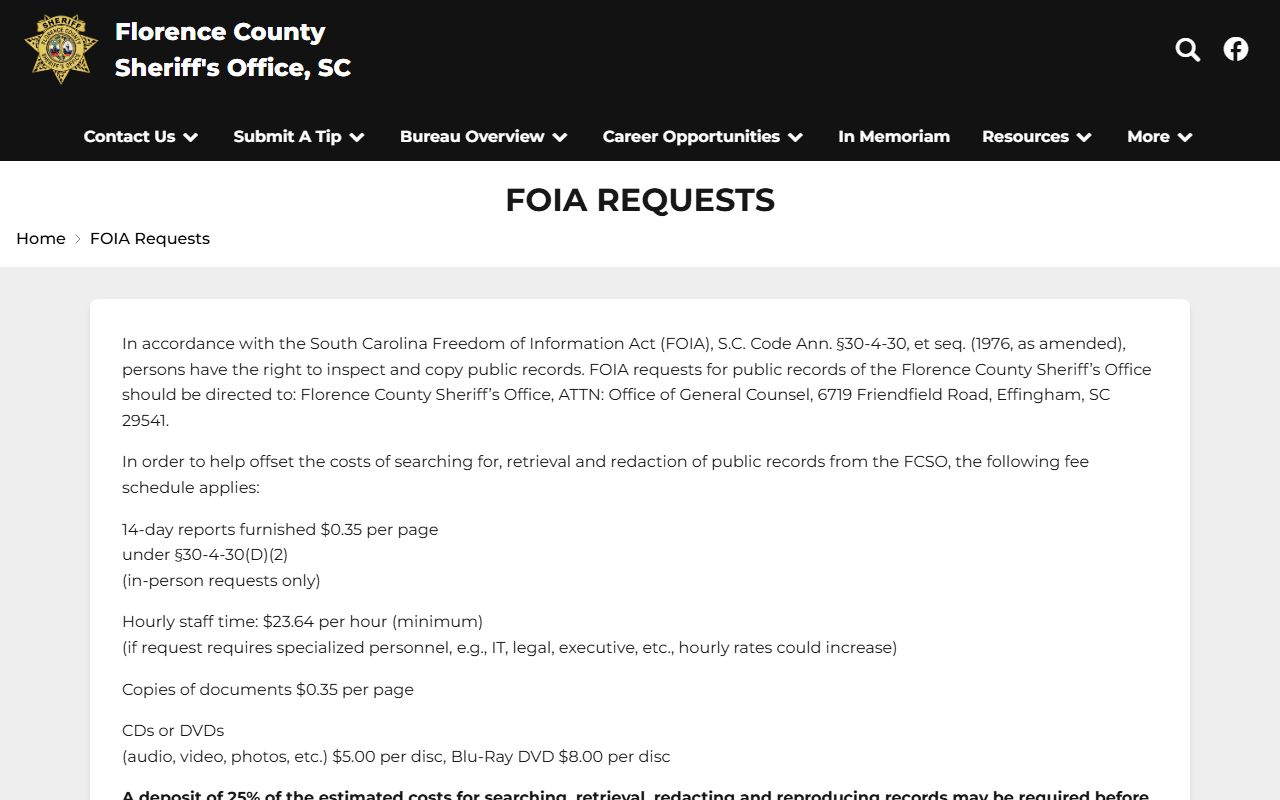
That FOIA route is most useful for sheriff-held material, while case results still need court or solicitor records.
Charges vs Convictions
Florence County arrest records and court charge records should not be read as proof of guilt unless the disposition shows a conviction. A person can be arrested and booked, then have charges dropped, amended, dismissed, or nol prossed. A conviction appears only after a guilty plea, guilty verdict, or similar finding. The sentence field, if public, will then show punishment such as jail, prison, probation, fines, costs, or restitution.
| Point | Charge | Conviction |
|---|---|---|
| Meaning | An accusation listed after arrest or filed in court. | A final finding or plea that establishes guilt. |
| Where to check | Booking portal, warrant list, public index, or court file. | Disposition and sentence entries in the court record. |
| Can change | Yes, it may be amended, reduced, or dropped. | Changes only by later order, appeal, or qualifying relief. |
The Magistrate and Municipal Court expungement process is important for lower-level dismissed, not-guilty, or nol-prossed charges.
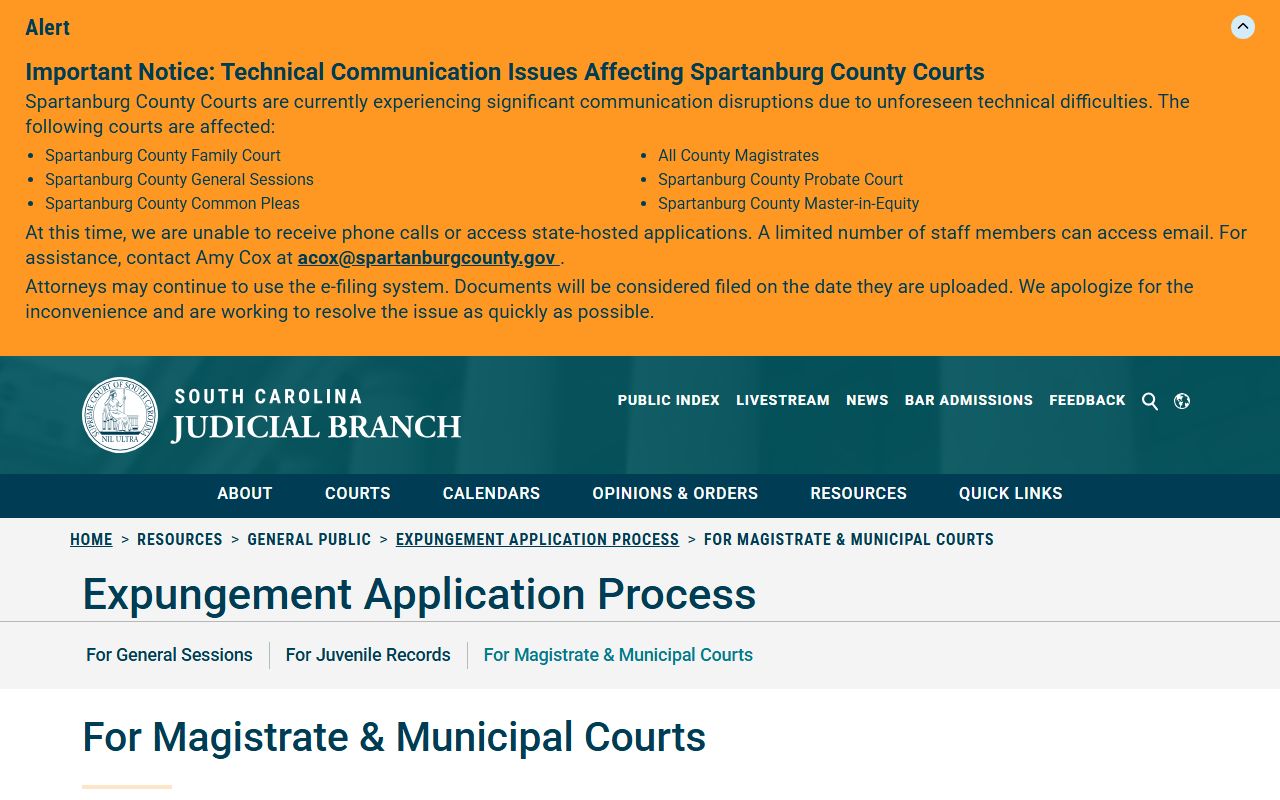
Summary court expungement guidance helps explain why a once-visible arrest or charge may later be restricted.
Florence Arrest Record Access Limits
South Carolina law gives public access to many records, but it also limits use and disclosure. South Carolina FOIA supports inspection and copying of public records unless an exemption or other law applies. S.C. Code Section 30-2-50 restricts using personal information from public records for commercial solicitation. FCSO also references detention booking access under state public-record law for recent county detention bookings.
The sheriff's app and site ecosystem includes inmate search, released inmates, sex offenders, SC Public Index, crime maps, pay tickets online, FOIA requests, submit a tip, anonymous tips, and active warrants. The submit-a-tip form includes a Warrants Tips category and fields for name, email, phone, submission type, tip text, incident location, and incident date or time. Tips are not the same as public records requests.
The FCSO submit-a-tip source shows the official form fields tied to sheriff app submissions.
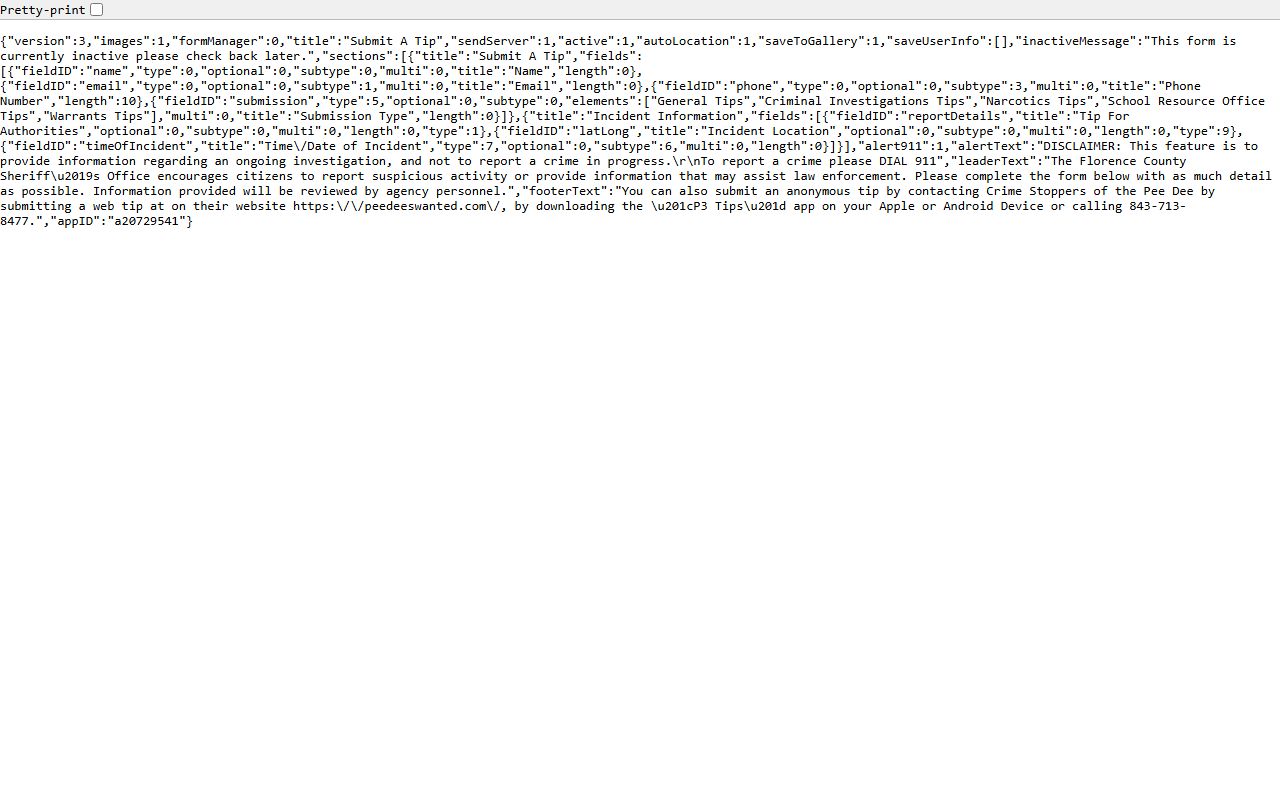
That source supports tip routing, not case lookup, so it should be used for information to law enforcement rather than court-record searches.
Statewide Charge Record Checks
Some charge-related checks are not county court files. The South Carolina sex offender registry is a statewide SLED-linked public tool and is also linked from FCSO. It is narrower than a criminal-history search because it covers registry information under registry rules. It does not replace Florence County court records, solicitor records, jail booking records, or certified copies from the Clerk of Court.
For a full South Carolina criminal-history product, users should follow the current state criminal-history process, not rely on a county page. For a Florence County charge outcome, the public index, court clerk, solicitor, or summary court is the relevant source. For arrest reports, FCSO FOIA is the local sheriff channel.
The SLED registry conditions page is one statewide charge-related source assigned to this page.
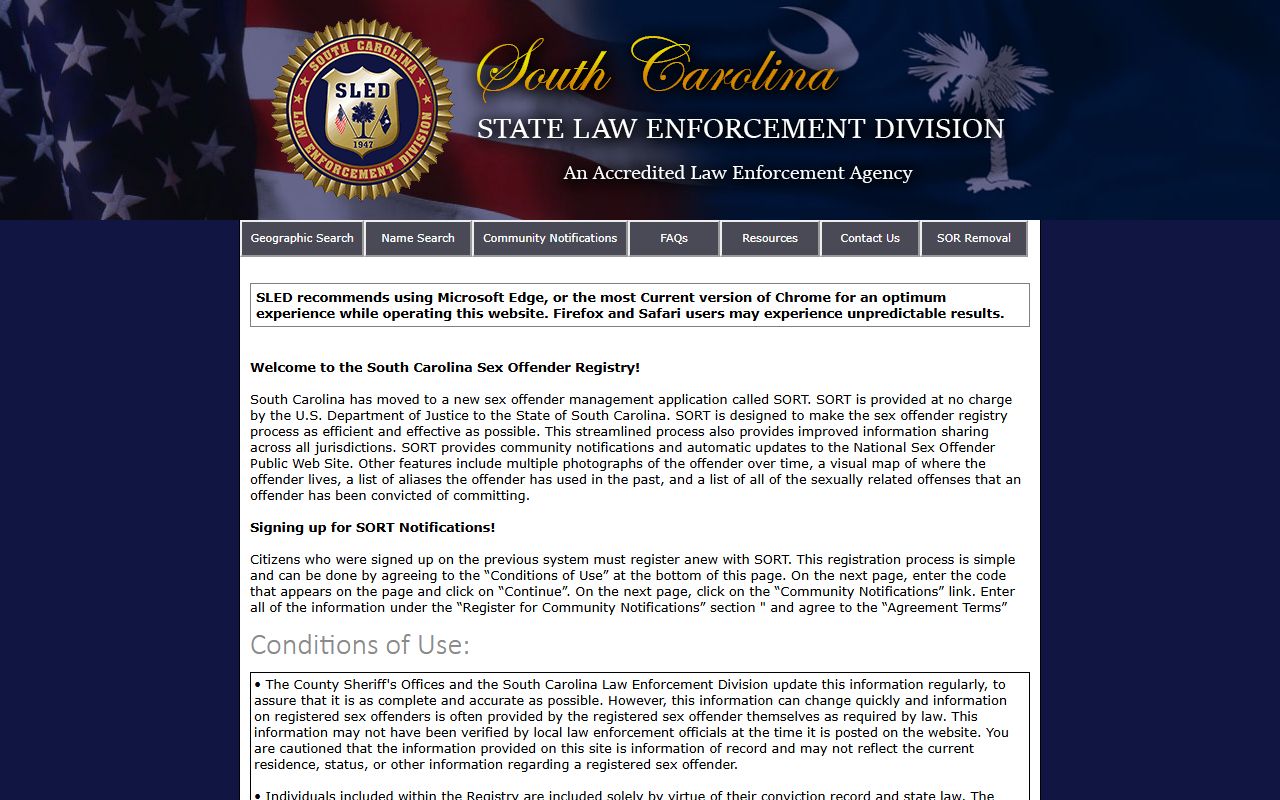
The registry link is useful only for registry checks, so readers should still verify court charges through Florence County court channels.
Restricted Florence Charge Records
Several Florence County charge records may be restricted. Juvenile records are confidential under South Carolina juvenile law. Adoption records are sealed. Sealed court cases and sealed documents are not available through the public index under court rules. Expunged charges may stop appearing in public systems after a valid order. Ongoing investigations may also limit what law enforcement releases.
| Record Type | Public Access Concern | Where to Verify |
|---|---|---|
| Juvenile charge | Usually confidential and not a routine public record. | Family Court or attorney. |
| Sealed case | Hidden from public access by rule or order. | Clerk of Court. |
| Expunged charge | Restricted after statutory process and order. | Solicitor, summary court, SLED, or Clerk. |
| Sheriff report | May contain exemptions or redactions. | FCSO FOIA channel. |
Note: Florence County arrest records can be public, but use of personal information for solicitation is restricted by South Carolina law.